
My Tired Prefrontal Cortex
AI has increased the number of things I can keep moving at once. My attention, my memory, and my ability to decide where to direct them haven't grown at the same rate.
Tired
My eyes ache. My scalp feels tight. Even my head seems to have shifted its center of gravity forward, as if my forehead weighs more than the back of my skull. Two or three hours at the computer leave me more tired than a whole day at work used to. I suspect I’m in good company.
I used to spend hours on a single feature or bug. I’d talk it over with someone, look things up, trawl Stack Overflow. I wasn’t staring at code in VS Code the whole time, but wherever I went, I took the same question with me.
In 2026, as models got better and I found more agents I liked, I started using AI a lot more. You could see it in my GitHub commits and pull requests. In a remarkably short time, I went from the thrill of having “mastered” working on several things at once, to being hooked on it, to being tired.
I can have agents work on requirements, technical research, visual design, and implementation at the same time. All I have to do is give instructions, grant permissions, check their work, and figure out how to make the whole thing run better.
It feels fast. Especially when several sessions light up with little green dots at once. I haven’t opened a single result yet, and I’m already pleased with myself. It feels like pulling cards in a gacha game. I imagine my dopamine levels are doing just fine at that moment.
Then I open the results. Well, it’s gacha. You rarely pull what you wanted. I collect myself, work out what’s off, rewrite the prompt, and pull again. Then it’s on to the next session to do the same thing. Somewhere in there I’ll notice a step I’ve done three times and start wondering if it ought to be an automation or a skill. I’m tweaking the workflow while I’m still using it.
A day goes by like that. Time passes as quickly when I’m deep into vibe coding as it does when I’m gaming. The difference is that I can die ten times fighting Malenia or Yang Jian and happily go back for another round. After a day of vibe coding, I’m tired.
Attention, switching costs, and what lingers
At first I thought I needed more breaks. Maybe forty-five minutes at my desk, then ten minutes up and about, like the breaks between classes at school. And perhaps I ought to run fewer projects at once. I’m no MacBook. I don’t have ten cores. So I started getting up every forty-five minutes and capped myself at three concurrent tasks. I still tired just as easily.
Then one morning I made myself resist the urge to pick up another task while the model was thinking. While I waited, I’d think about what I was already working on or just zone out. I’d do one thing all morning. From 9:30 to 11:50 I got up once to stretch. By the end my scalp felt fine, and my head was clear. Roughly the same time at the computer, roughly the same effort as far as I could tell. But those two hours felt quite different when I spent them on one thing instead of three.
What was going on?
Over lunch I got to thinking about badminton. Maybe there’s something in mental work that feels like the difference between a steady run and all the starts and stops on court. With the same pair of legs, I can run for half an hour and want a breather after ten minutes of badminton.
Part of what separates a professional player from an amateur is how much further the pro can make their energy go. Watch their footwork, the way they set the pace, how well they use the few seconds between rallies. Could I be using my brain, or more precisely my attention, about as economically as an amateur chasing a shuttle around the court?
I described the feeling and my guess to GPT and asked whether there was research behind it. The reply ran to what looked like eight or nine pages. The gist was that the fatigue might have more to do with the sustained effort of directing my attention than with burning through enormous amounts of energy.
The papers and reviews it cited described a familiar finding. When people switch from task A to task B, they tend to respond more slowly and often make more mistakes, even when they know a switch is coming. Two processes figure in the explanation.
- Task-set reconfiguration. I have to bring the new goal, its rules, and the information I need back to mind.
- Task-set inertia. The rules I was using a moment ago can stick around and get in the way.
From my chair, all I’ve done is switch windows. In the background there’s a fair bit of letting go of one set of rules, picking up another, and keeping the old one from interfering.
Try teaching a two-year-old to open the fridge. Easy, right? Your hand already knows to pull hard against the seal, feel the instant it gives, ease off just enough, and swing the door the rest of the way without flinging it open. Force, feedback, how far you want the door to go. A lot fits inside the words “open the fridge.”
I have a lot of sympathy for the robots that face-plant or run into walls during a race. :D
Back at my desk, here’s what starting three agents might look like.
| Agent | Current task | What I have to bring back to mind |
|---|---|---|
| A | Fix a UI component | Layout, state, styles |
| B | Research agent frameworks | Options, criteria, evidence |
| C | Prepare a product for release | Brand positioning, visual language, design constraints |
The agents can work simultaneously. When I read, review, or make a call, I still have to find my way back into each task. Models have a context management problem. So do I.
There’s another cost that’s harder to spot. Even after I’ve settled into the next task, I haven’t quite cleared the last one from my head. Some of my attention is still back there. That lingering pull might explain my particular brand of tiredness better than the switch itself.
I catch myself doing this all the time. I don’t even switch back to the other session. I just glance at its tab. Still spinning? Green dot yet? I’m eating from one bowl with my eye on what’s cooking in the pot. That takes something out of me, too.
In 2009 Sophie Leroy studied what she called attention residue. When you move on from unfinished work, some of your attention can stay with it, and your performance on the next task can suffer.
Nobody in that 2009 study was juggling coding agents, of course. But the experience rings true for me, and AI has given a lot more people a lot more chances to have it.
A feature I built myself might take hours or days. It was hard, but for most of that time I was turning over one problem. Now I can hand it to an agent in five minutes and start on something else. Handing off a task doesn’t mean I’ve finished with it in my head.
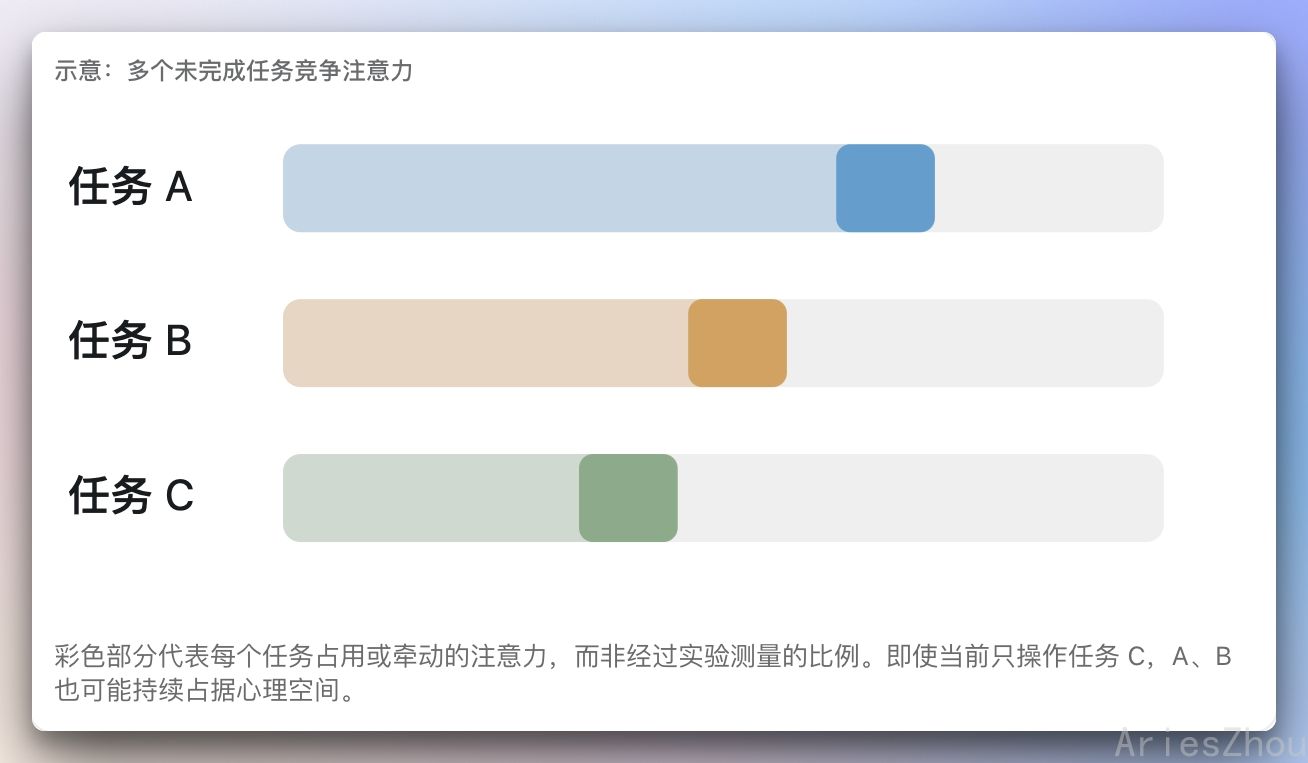
My computer can run work asynchronously. My brain doesn’t always let me offload it quite so neatly. A lot of unfinished jobs stay open, each asking a little of me. AI can produce information faster than I can understand it, make a judgment, and sign off on the result. The straws on this camel’s back are piling up awfully fast. 😫
About that prefrontal cortex
I nearly called this piece “My Tired Forehead.” Look, my forehead felt tight. As someone with limited literary ambitions and a preference for saying what I mean, I was quite happy with that title. Then GPT gave me a tour of neuroscience and metabolism, suggested a connection between my tight scalp and fatigue-related changes in the prefrontal cortex, and proposed “My Tired Prefrontal Cortex.” An expert opinion and a fancier title? Naturally I took it.
The explanation came with a formidable number of technical terms. After two rounds of friendly but fairly explicit requests for plain language, here’s what I took away. The prefrontal cortex helps us hold things in working memory, keep a goal in mind, and direct what we do. Sustained, demanding mental work may be accompanied by metabolic changes in particular prefrontal regions and signs of fatigue.
Switching tasks, processing incoming information, continually steering my attention, keeping all that going, and leaving too little time to recover: it’s quite a workload.
What seems worth trying, then, is to match the effort I’m making with enough recovery. That means allowing for the attention I didn’t realize I was spending and leaving myself a little slack. I can stop trying to wring the last drop out of every hour.
Back on the badminton court, good players don’t spend a match trying to keep their heart rate low or steady. They choose their shots and footwork well, decide when to push, and recover when they get the chance.
At my desk, I’d like to get better at telling a few things apart.
- Hard thinking that’s worth doing, and switches I could have spared myself.
- Choosing to concentrate, and letting an agent notification choose for me.
- Taking a break, and picking up a different task.
It also helps to remember what I wanted from a Pomodoro timer in the first place: a boundary around a stretch of sustained attention.
I walked cheerfully into the high-concurrency trap AI had laid out for me. I gained the ability to start more things at once and somewhere along the way lost that boundary.
So that’s my immediate plan. Lighten the load a little, change the pace, leave myself time to recover.
One last thing
“Why hasn’t AI made my life easier?” Some version of that question has come up in so many of the books, blogs, newsletters, and podcasts I’ve spent time with this year. Maybe AI did save us time. We were just very quick to fill it with more work.
We’re afraid of missing the moment. We worry we haven’t made anything big enough. We’ve become the bosses we used to complain about for squeezing their workers dry. Funny what a change of seats does to your perspective. We joke about how hard we’re working our agents, until we’re worn out or get sick and it dawns on us who else has been working those hours.
I used to spend a lot of time thinking about how to make machines run faster. I’d like to spend some of it now thinking about how to get them to interrupt me less and leave more of my day to me. Personal time management only goes so far. AI can keep at a task indefinitely. I can’t.
As the machine’s ability to get things done becomes less of a bottleneck, I wonder if the skill I need to relearn is how to look after the attention I have and spend it well. I’ve had plenty of practice starting more things and doing them faster.
Take your time. An agent’s long-running task is measured in hours. Ours are measured in months and years. I hope you get some rest.
References
- ChatGPT, at considerable length
- Monsell (2003), Task Switching
- Leroy (2009), on attention residue
- Wiehler et al. (2022), on cognitive control and neurometabolism
- Reviews and related research on cognitive fatigue, 2025–2026
- Empirical surveys on AI work intensification and “AI brain fry,” 2026