REA and Reverse Engineering
An open-source project on GitHub called REA (Reverse Engineer Anything) has been really popular lately.
It’s an MIT-licensed CLI tool and an MCP server. It connects decompilation engines such as IDA and other analysis tools to agents such as Claude Code and Codex. An agent can use it to take an app apart and produce details such as pseudocode, symbols, and strings, making it easier to build something similar. The slogan is just as blunt: “See a feature you like. Understand how it works, down to the binary level.”
The project was already open source back in April. After 6.0 shipped on October 8, it was shared widely on X and YouTube, and its star count shot up within days. By October 14, it had passed 210,000.
Wey Gu posted a tweet on X that captures how a lot of people feel:
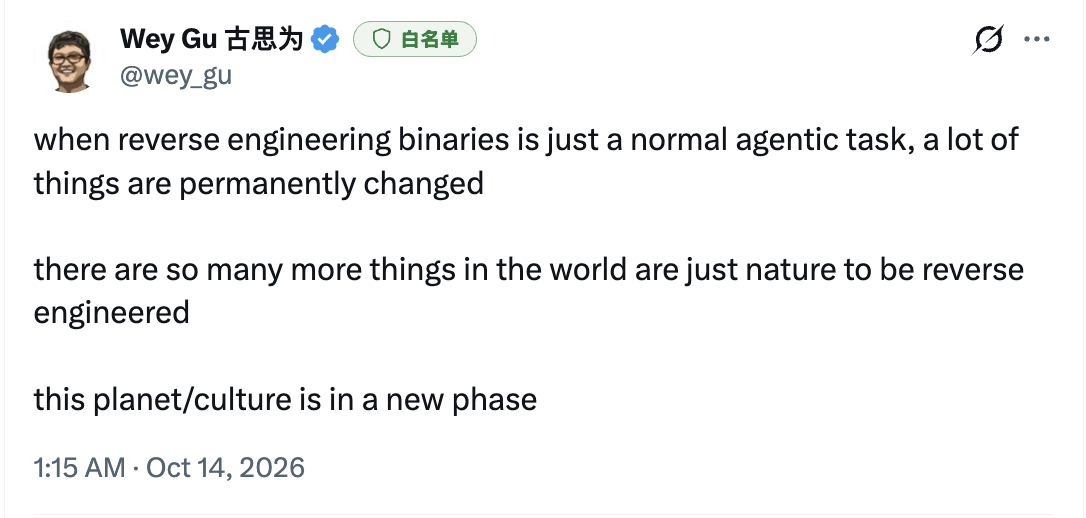
The gist: once reverse engineering binaries is just a normal agent task, a lot of things have changed for good; there are so many more things in the world simply waiting to be reverse engineered, and this planet and its culture are entering a new phase.
I agree that “the barrier has been lowered for good,” but I see the direction of the “change” a little differently.
Back when I was working on data encryption and decryption, I had a few conversations with reverse engineers at several of China’s leading security companies and learned about their day-to-day work and frustrations. Here are a few rough thoughts.
In China, reverse engineering usually serves a few purposes. One is analyzing malware such as viruses and then hardening your own products, which is mainly defense. Another is analyzing vulnerabilities to help others improve their products, like bug bounty hunters, which is mainly analysis. A third is cracking software to bypass licensing or make derivative versions, which is mainly about profit. There are other directions too, but I won’t go through them one by one.
Reverse engineering itself is a hard, tedious skill that takes real dedication. But once it becomes as easy as programming, the field probably won’t see a flood of newcomers and new software the way vibe coding did. Instead, the field may shrink, especially that third kind of work. Its goal is to analyze a piece of software from the roots up and then build a copy, but now you can clone software starting from the surface, and much faster than reversing it. What the code looks like doesn’t really matter.
There has long been a technical arms race between reverse engineering and software protection. The most common forms are red team vs. blue team exercises between companies, and Huwang cyber-defense exercises (Huwang covers far more than reverse engineering, of course, but reversing is a very important part of it).
Beyond that, software encryption, packing, obfuscation, anti-debugging, and anti-tampering are all closely tied to reverse engineering. You could even say they grew out of the contest with it.
REA’s arrival will directly make encryption, packing, and the like pointless for ordinary software, pushing software to just “give up” and become transparent. Software that relies on large services or platforms may fare a little better, but standalone software from individuals or small teams probably can’t escape it.
Honestly, I don’t think there’s much worth reversing. Anyone who has seriously written code for years knows there’s nothing in code that needs encrypting or hiding. At worst, people make fun of you for writing it badly hhhhh. Encryption and protection are more of a commercial defense against unfair competition. The point is protecting intellectual property, like patented techniques and algorithms, not the code itself.
To me, REA’s popularity looks more like handing people outside security a key to Pandora’s box. Reverse engineering used to sound a bit mysterious, and kind of cool. Now anyone can give it a try, but they may well open the box and find that what’s inside is nothing special after all😂
So I don’t think this reverse engineering wave will last. For one, curiosity fades easily; for another, software worth reversing, or reversing worth doing, will only get scarcer.